Control Devices with Your Thoughts? The Surprising Present and Future of Brain-Computer Interfaces
This blog post explores a 2023 review paper by Edelman, Zhang, and Schalk on non-invasive Brain-Computer Interfaces (BCI), published in IEEE Reviews in Biomedical Engineering. It covers the current state and future trends of BCI technology, focusing on EEG as the most practical tool. The post explains active vs. passive BCI, key findings on accuracy improvements and device miniaturization, and how LINK BAND embodies passive BCI principles through prefrontal EEG measurement.
What if you could open the curtains with your thoughts instead of reaching for your phone in the morning?
Have you ever seen a movie or TV show where someone controls a computer or moves a robotic arm without lifting a finger, just by thinking? It sounds like science fiction, but this technology is already closer to reality than you might imagine. It is called a Brain-Computer Interface, or BCI for short. This technology reads the tiny electrical signals produced by the brain and translates them into commands for machines. It is no longer just a fantasy from sci-fi novels.
But here is an important question: How far has this technology actually come, and how will it change our daily lives in the future? Today, we are going to explore the current state and future of non-invasive BCI technology through a 2023 review paper titled 'Non-Invasive Brain-Computer Interfaces: State of the Art and Trends' by Bradley Jay Edelman, Shuailei Zhang, and Gerwin Schalk, published in IEEE Reviews in Biomedical Engineering. This paper has been cited 171 times, establishing itself as a leading review in the field.
Why This Study Is Special
There are already numerous studies in the BCI field. However, most existing research either focuses on a single technology or has been conducted over short periods in small-scale laboratory settings. For example, while there have been many experiments using brainwaves to move robotic arms, few studies have comprehensively addressed how useful these technologies can be in real daily life and how different technologies connect with one another.
This is precisely where this paper stands out. Edelman and his colleagues did not simply introduce one technology. Instead, they mapped out the entire landscape of non-invasive BCI technology. They compared various signal measurement methods, including electroencephalography (EEG), functional near-infrared spectroscopy (fNIRS), and magnetoencephalography (MEG), discussing which technology is most effective in which situations and what applications are opening up, from clinical treatment to gaming, education, and rehabilitation.
Above all, this paper focuses on the 'non-invasive' aspect. Unlike invasive methods that require implanting electrodes in the brain, non-invasive BCI is safe, affordable, and accessible to many people without burden. This means BCI technology can extend beyond a small number of patients and researchers into the daily lives of the general public. This is the very trend that has given rise to wearable EEG devices like LINK BAND.
How Was the Research Conducted?
This paper is not a study that conducted new experiments, but rather a 'review paper' that systematically analyzes and synthesizes numerous previously published studies. Therefore, the research method itself focuses on literature review, technology classification, and trend analysis. Let us take a closer look at the process.
Four Key Signals of Non-Invasive BCI
Edelman and his colleagues first organize the representative signal measurement methods used in non-invasive BCI into four categories. The first is electroencephalography (EEG), which is most familiar to us. It measures the brain's electrical activity by attaching electrodes to the scalp, offering excellent temporal resolution and relatively low equipment cost. The second is functional near-infrared spectroscopy (fNIRS), which uses infrared light to measure the oxygen saturation of blood flow in the brain. The third is functional magnetic resonance imaging (fMRI), which offers excellent spatial resolution but requires large, expensive equipment. Finally, magnetoencephalography (MEG) measures the brain's magnetic fields, providing very high precision but also requiring large-scale equipment.
Among these, EEG has established itself as the most essential tool for non-invasive BCI. It is affordable, portable, and capable of processing signals in real time. This is precisely why LINK BAND has adopted EEG sensors.

Two Major Branches of BCI: Active and Passive
The paper broadly divides BCI into two categories. The first is 'active BCI,' where users intentionally think or imagine something specific to control a machine. For example, imagining moving the right hand causes a robotic arm to move. The second is 'passive BCI,' where the system monitors the brain's state and provides information without the user having any specific intention. Real-time detection of focus, fatigue, and emotional states are typical examples.
Interestingly, interest in passive BCI has been growing rapidly in recent years. This is because passive BCI can be used naturally without requiring special training. This is also why wearable devices like LINK BAND are gaining attention.
From Clinical to Everyday: Expanding Applications
The paper broadly categorizes BCI applications into clinical treatment, rehabilitation, education, gaming, and daily life support. What is particularly noteworthy is that BCI is no longer a technology solely for severely ill patients. For example, the scope of BCI applications is rapidly expanding, from focus training for children with ADHD to emotional regulation for depression patients and stress management for the general public.
Key Findings: Where BCI Stands Now and Where It Is Heading
The most important message of this paper is clear: non-invasive BCI is now moving beyond the laboratory into real life, and EEG technology is at the center of this shift. Let us examine the key findings emphasized in the paper one by one.
1. The accuracy of non-invasive BCI is rapidly improving
In the past, there was a perception that non-invasive BCI had significantly lower signal quality compared to invasive BCI. However, thanks to recent advances in machine learning and signal processing, the classification accuracy of non-invasive BCI has greatly improved. According to the paper, in certain tasks, non-invasive BCI achieves over 90% accuracy. This is a level that was unimaginable just a decade ago. In particular, EEG-based BCI shows stable performance in motor imagery tasks, and P300-based speller systems have reached a level where several characters can be typed per minute.
2. Passive BCI is opening new possibilities
The paper predicts that passive BCI will be the fastest-growing area in the future. Active BCI requires users to create specific brainwave patterns through training, which can be burdensome, but passive BCI simply monitors natural brain activity. For example, EEG can detect when a user's concentration is dropping and prompt a learning app to suggest a break, or provide meditation guidance when stress levels rise. This shows that BCI can go beyond being a tool for specific purposes and become an everyday wellness tool.
3. EEG devices are becoming smaller and more affordable at an accelerating pace
The paper emphasizes that consumer EEG devices are rapidly spreading. Research-grade EEG equipment that once cost tens of thousands of dollars is now being replaced by consumer devices costing hundreds of dollars. While these devices have fewer electrodes, they provide sufficiently useful data for specific purposes such as focus measurement, meditation assistance, and sleep monitoring. LINK BAND's measurement of brainwaves in the prefrontal region (Fp1, Fp2) is an extension of this very trend.
4. The convergence of BCI and everyday technology is in full swing
The paper explains that BCI is no longer an independent technology but is converging with existing technologies such as smartphones, wearable devices, virtual reality (VR), and games. For example, systems that integrate EEG sensors into VR headsets to change the virtual environment based on the user's emotional state are already being developed. This convergence is becoming a key driving force in transforming BCI from a specialized technology into an everyday one.
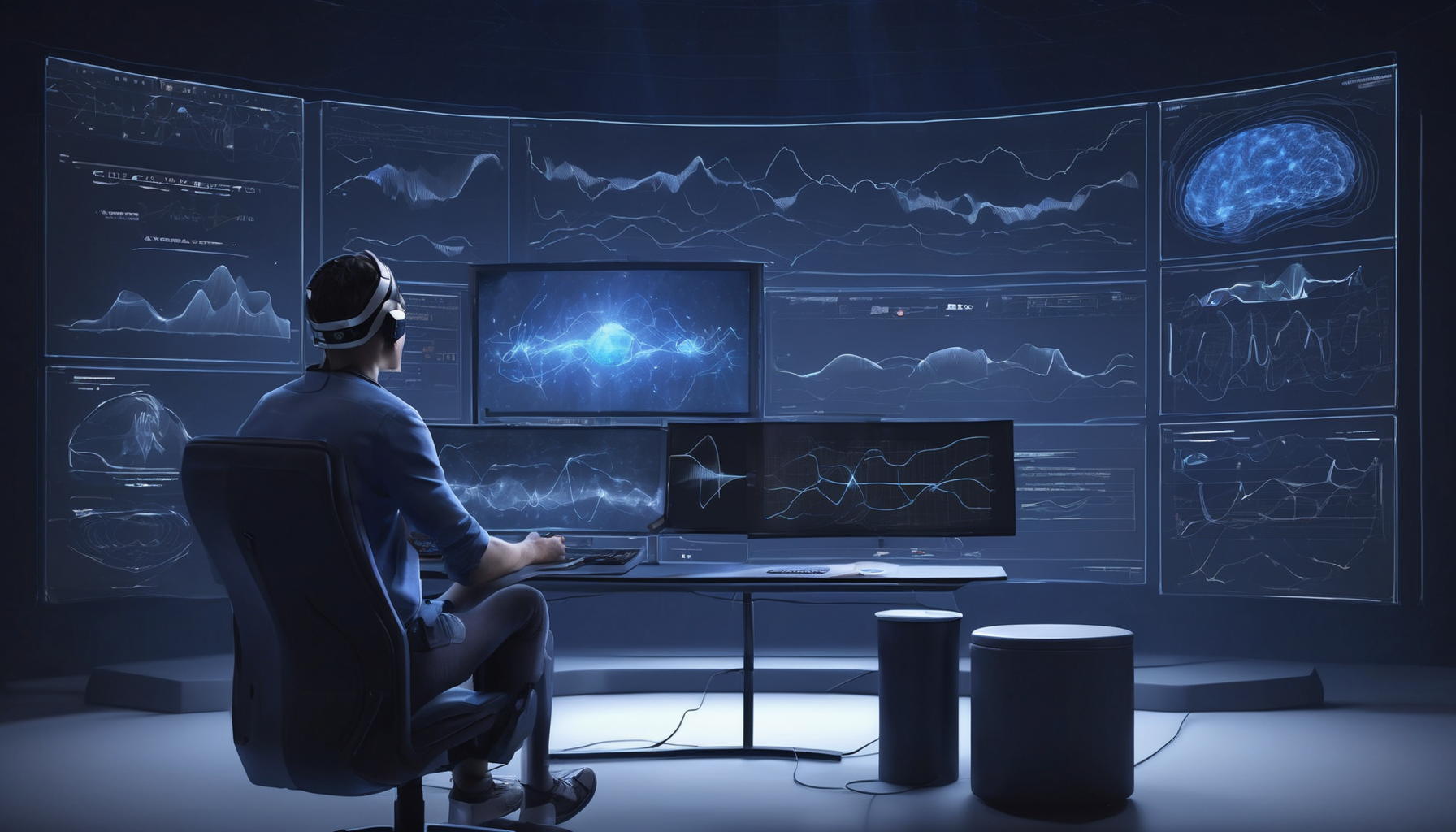
[IMAGE: A conceptual diagram showing a person controlling various devices using brainwaves. A user wearing a headband controlling a smartphone, computer, and lights]
How Does This Relate to My Life?
Now, take a moment to imagine. You are trying to maintain focus before an important project. But what if your smartphone suddenly tells you, 'Your concentration is dropping. How about taking a 5-minute break?' Or what if, during meditation, you receive feedback saying, 'Your brainwaves are more stable than usual today'? This is the future of daily life that this paper envisions.
BCI is no longer the exclusive domain of severely ill patients or researchers. As this paper shows, non-invasive BCI technology is already ready to permeate our daily lives. It can provide practical help for the issues we worry about every day, such as focus management, stress relief, sleep improvement, and emotional regulation. In particular, the advancement of passive BCI is opening the path for us to utilize brainwave data without special training.
Of course, there are still many challenges to address, including signal noise issues, individual differences, and privacy concerns. However, as the paper emphasizes, the pace of technological development is very fast, and we are already standing at the threshold of an era where BCI becomes part of everyday life.
Exploring with LINK BAND
So how is LINK BAND realizing the insights from this paper? LINK BAND is a wearable headband that measures brainwaves through EEG sensors attached to the prefrontal region (Fp1, Fp2). This can be considered a representative example of the 'passive BCI' emphasized in the paper.
When you wear LINK BAND and run a meditation app, your brainwaves are measured in real time. When alpha waves (8-12Hz) increase, it signals that the brain is entering a relaxed state, and when beta waves (13-30Hz) increase, it means an alert state is being maintained. Based on this brainwave data, LINK BAND visualizes your focus, relaxation, and stress levels.
The core of passive BCI mentioned in the paper is 'monitoring without disrupting natural brain activity.' LINK BAND has its strength precisely at this point. Without complex training or special intention, it can naturally track your brain state during everyday activities. For example, if LINK BAND detects a drop in focus while you are studying, the app can send a notification suggesting a break. After a meditation session, you can check brainwave changes through graphs and understand your own relaxation patterns.
[IMAGE: https://linkband.looxidlabs.com/images/linkband-store/woman-wearing.jpg]
LINK BAND captures brain activity related to focus, decision-making, and emotional regulation by measuring the prefrontal region in particular. This allows you to actually experience the possibilities of 'everyday BCI' emphasized in the paper. Without complex research equipment, you can check your brain state as data and use it to build better habits.
Small Experiments You Can Try Today
So how can you apply the content of this paper to your daily life? Here are specific action items you can try starting tomorrow.
1. 5-Minute Morning Brainwave Check-In: Tomorrow morning, put on LINK BAND and sit quietly for 5 minutes to observe your brainwaves. Recording what your morning brain state looks like and the balance between alpha and beta waves will help you understand your focus patterns throughout the day.
2. Before and After Focus Work Comparison: Measure your brainwaves for 3 minutes each before and after starting important study or work. You will be able to confirm a pattern where beta waves are high before work and alpha waves increase after work. This data is useful for finding the optimal focus time that suits you.
3. Recording Brainwave Changes After Meditation: Meditate for 10 minutes before bed and check the brainwave changes in the LINK BAND app. Recording the increase in alpha waves before and after meditation allows you to objectively understand how meditation actually affects your brain.
These small experiments will be the first step in directly experiencing the everyday use of 'passive BCI' emphasized in the paper.
Questions This Study Asks You
After reading this paper, several questions naturally come to mind. What do you think?
First, if you could know your emotions and focus in real time through brainwaves, how would your day change? Would knowing lead to a better life, or would it become another source of stress?
Second, brainwave data is very personal information. What ethical standards should we establish in the process of collecting and utilizing such data? Where should we find the balance between convenience and privacy?
Third, as BCI technology advances, a future where we 'control devices with our thoughts' draws closer. In such a world, what meaning would human 'will' and 'action' have? As technology understands our brains better, will we come to know ourselves better?
References
Edelman, B. J., Zhang, S., & Schalk, G. (2023). Non-Invasive Brain-Computer Interfaces: State of the Art and Trends. IEEE Reviews in Biomedical Engineering. DOI: 10.1109/RBME.2023.3302375
LINK BAND Insight
LINK BAND represents the practical realization of passive BCI technology described in this paper. By measuring EEG signals from the prefrontal region (Fp1, Fp2), LINK BAND allows users to monitor their focus, relaxation, and stress levels in real time without requiring special training. This aligns with the paper's emphasis on passive BCI as the fastest-growing application area, where natural brain activity is monitored to provide meaningful feedback for everyday wellness, meditation, and cognitive optimization.
Related Articles
Measuring Developers' Cognitive Load in GenAI-Supported Development: The Role of Wearables
Generative AI is changing software development workflows. In a four-day industrial field study at two SAP sites, 21 developers documented their tasks, GenAI use, and perceived cognitive load while wearing an EmbracePlus wristband. Results show that perceived cognitive load is associated with both GenAI use and task context, while physiological measures provide only limited additional information.

AI Meets Neuroscience: Redefining Learning Efficiency Beyond Cognitive Load Theory
This study challenges the traditional Cognitive Load Theory by integrating Educational Neuroscience and Artificial Intelligence to redefine learning efficacy. It highlights how AI-driven adaptive learning systems can use real-time biosignals like EEG to measure cognitive load and personalize learning. The findings suggest that cognitive load is dynamic and can be managed to achieve an optimal 'flow zone' for learning.
Train Your Brain Like a Muscle: What a 534-Citation Neuroscience Review Reveals About EEG Neurofeedback
The moment you open your eyes in the morning, smartphone notifications pour in. Work emails, KakaoTalk, Instagram alerts, news headlines… Your brain is bombarded with information as soon as you wake up. You sip your coffee and get ready for work, but your mind is already full of tangled thoughts. “I need to nail that presentation at today’s meeting…,” “I can’t focus—probably because I worked late last night.” Have you ever had this experience? Every day, we make countless decisions, process information, and regulate emotions. But how often do we actually check whether our brain is in optimal condition? What if we could train our brain, just as athletes train their muscles? To find answers to this question, neuroscientists around the world have been researching for decades. And one powerful tool that has emerged is EEG neurofeedback. Today, I want to introduce you to an influential review paper published in *Neuroscience and Biobehavioral Reviews*, cited 534 times. This paper goes beyond simply explaining brainwaves—it uses meta-analysis to examine specific protocols that can actually improve cognitive abilities and emotional states in healthy individuals. Let’s explore the scientific method that can upgrade your daily performance.
Experience LINK BAND 2.0
Measure your brainwaves in real-time with integrated EEG, PPG, and ACC sensors. See for yourself what you read about today.
View Product→